A development goal needs a future responsibility and an opportunity to apply it. High potential alone does not provide either.
Reviewed against sources available on 2 November 2026. Preview behaviour and final-release details may differ.
Write the player’s next job before changing training
Choose the responsibility the player could realistically perform in your squad. Describe the receiving positions, the support they need and the defensive work they would still owe the team. A nominal position code helps discovery, but it does not establish that every player listed there can execute the same role with the same level of independence.
Open the player’s available development and training information in your edition. Official material confirms that individual work can address personal development, positions and traits; it does not supply a universal setting for every prospect. The pictured effectiveness panel is context for team fit, not a screenshot proving a particular individual-training button sequence.
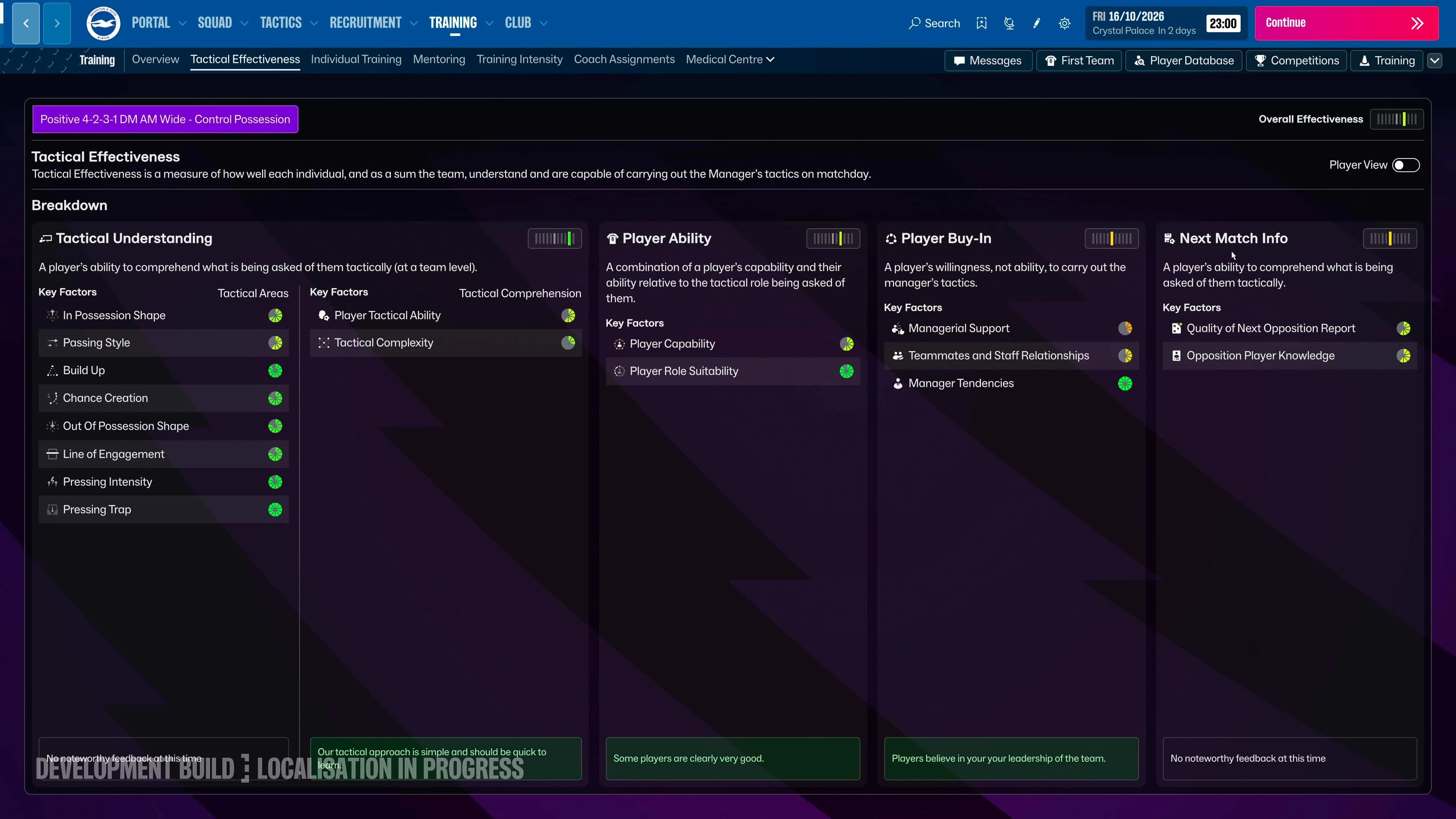
Official development Tactical Effectiveness panel. This illustrates the team context to inspect; it is not an individual-training menu or proof of a specific growth result.
Official development screenshot · localisation in progress · © Sports Interactive / SEGA. Publisher source · View full-size original · Checked 2026-11-01Choose one objective you can explain
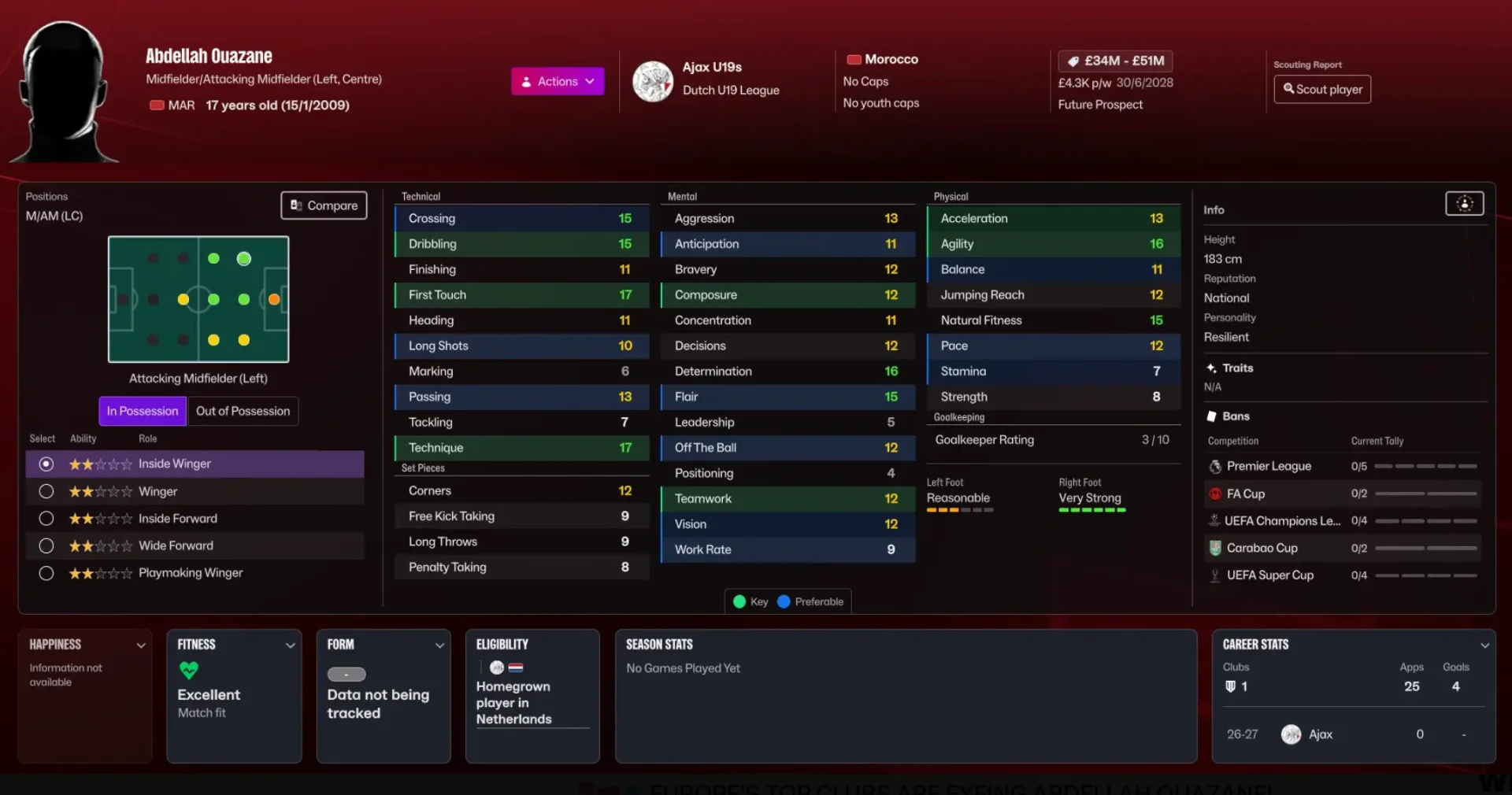
Compare the intended responsibility with the information actually known about the player. Where the public database lacks an attribute, obtain evidence in your own save instead of treating the blank cell as a weakness. Where an adult reference profile supplies values, keep its source date visible and verify the current report before basing a development decision on it.
Select an appropriate individual option that is visible in your build and record why you chose it. Review its load alongside team preparation and the opportunity the player will receive. Do not promise an exact rate of attribute improvement, a guaranteed positional conversion or an eventual PA outcome: none follows from a public reference profile or a single training choice.
Name the responsibility
Describe a current or attainable future squad job.
Check the evidence
Use the player’s actual report and identify fields still unknown.
Choose the visible option
Record the selected individual objective and the current game version.
Set a review point
Inspect feedback, role exposure and load together before adding another task.
| Record | Useful evidence |
|---|---|
| Objective | The responsibility the player is working toward |
| Current evidence | Report coverage and known attributes |
| Opportunity | Appropriate appearances or a credible alternative route |
| Review | Feedback and what changed since the last decision |
Reassess the opportunity as the squad changes
A first-team signing or a change of formation can close a pathway that looked sensible earlier. Revisit the objective when that happens. Keeping a prospect on the same plan while removing the role they were preparing for can turn a clear development choice into an exercise that no longer serves the squad or the player.
At the review, separate progress, opportunity and uncertainty. A player may need a different job, a different level of responsibility or more information before you make the next decision. The academy guide covers the club-wide pathway; this page owns the individual objective. Neither a popular training label nor the source’s potential value replaces an honest review of what the player can actually do.
Sources & verification
Article reviewed on 2 November 2026. Each source has its own verification date. Guidance is editorial analysis unless explicitly attributed to an official announcement.
- Official sourceOfficial FM27 Training and Tactical Effectiveness deep diveReviewed 2 November 2026