Choose the team problem first, then inspect the whole fixture block. No universal best schedule or guaranteed development multiplier has been established.
Reviewed against sources available on 2 November 2026. Preview behaviour and final-release details may differ.
Start with one football task
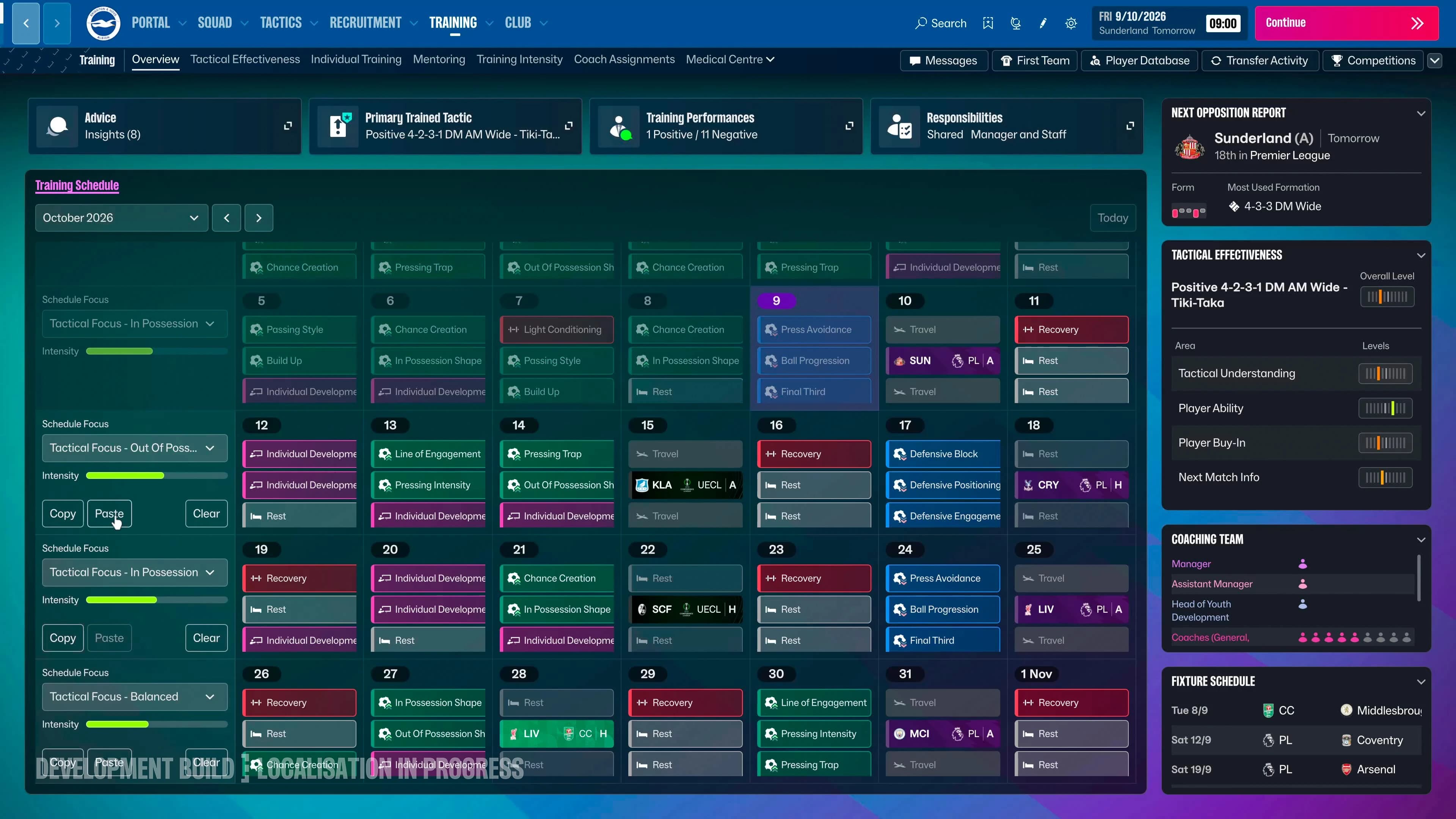
Open Training from the primary navigation and inspect the Overview before copying a week. The official development screenshot below identifies the schedule and load context; your edition or landing-screen preference may present the information differently. The navigation is source-confirmed, while the sequence here is an editorial planning routine rather than an imported schedule.
Write one team objective, such as supporting the first pass out of defence or keeping the midfield connected behind pressure. Identify the next fixture and the time available to work on that objective. Avoid choosing sessions merely because their names sound ambitious: you need to explain which observed difficulty the week is intended to address.
Inspect the fixture block
Check the next match and the following weeks before repeating a plan.
Choose one team need
Write down the behaviour you want to improve and the evidence behind it.
Review the available sessions
Select a relevant option shown in your build; do not substitute a guessed menu path from another edition.
Change the planning brief when fixtures change
For a quieter week, there may be more room to work on a recurring collective problem. In a congested block, first check the visible load and match-preparation demands before carrying over the same plan. These are planning priorities, not a tested Monday-to-Sunday preset, a medical recovery formula or proof that a specific intensity is safe for every player.
The ability to copy schedules can save administration, but the copied plan should be treated as a draft. Compare the new fixture pattern with the week it came from, including travel and availability where shown. Review any individually demanding work alongside the collective plan instead of assuming that each decision consumes a separate, unlimited capacity.
| Context | Priority to inspect | Reason to revise |
|---|---|---|
| A quieter week | One recurring team responsibility | The original problem has changed |
| Closely spaced fixtures | Visible load and immediate preparation | The copied week adds commitments that no longer fit |
| Several new starters | Shared understanding of a small set of duties | The plan asks too many new movements at once |
| Development focus | Individual goal alongside team work | The prospect has no realistic opportunity to apply it |
Review the week against the task you wrote down
Before the next match, compare the relevant feedback with your starting note and inspect whether the intended players are available to carry out the plan. After the match, record examples of the responsibility working and failing. A favourable result is useful context, but it does not by itself prove the chosen schedule caused the improvement.
Keep the original week and the reason for changes in a small planning log. If the issue persists, decide whether the training task was wrong, the tactical demand was excessive or the evidence is still incomplete. The parent training guide explains the system; this page owns the weekly choice, while individual training belongs to a separate player-development brief.
Sources & verification
Article reviewed on 2 November 2026. Each source has its own verification date. Guidance is editorial analysis unless explicitly attributed to an official announcement.
- Official sourceOfficial FM27 Training and Tactical Effectiveness deep diveReviewed 2 November 2026