
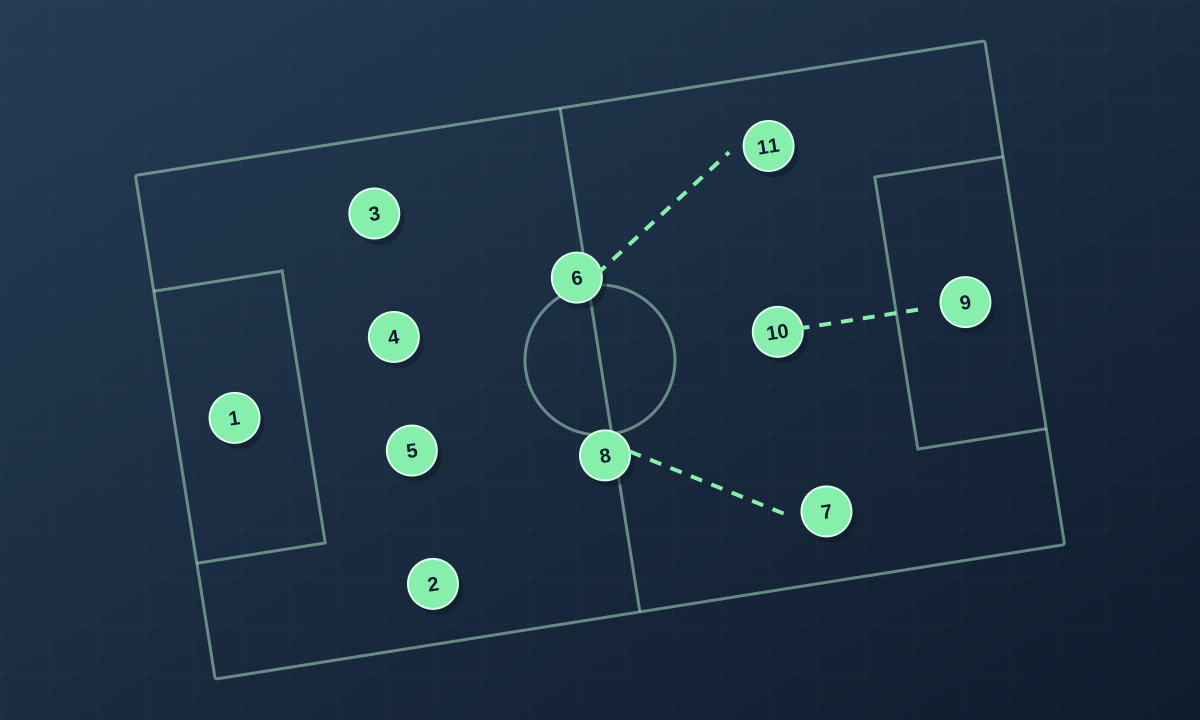
A formation describes the starting structure. Your roles, instructions and transitions determine what that structure becomes during the match.
Reviewed against sources available on 28 October 2026. Preview behaviour and final-release details may differ.
4-2-3-1: a link behind the striker
A 4-2-3-1 gives you a player between midfield and the main striker, with wide attacking options on either side. As a football structure, it can offer a clear route from the deeper midfield pair to the attacking line. The important question is whether that pair can cover the spaces left when other players advance.
Do not assume the two deeper players have identical jobs. Decide how you want possession to move forward and who remains available when an attack breaks down. If both full-backs and both midfielders leave their positions at the same time, the formation label alone will not protect the centre. Use match observations to identify the actual locations of your players.
4-3-3: build around midfield balance
A 4-3-3 with a deeper midfielder offers a reference point in front of the centre-backs. Two midfielders can then support the attack, while the wide players provide different routes towards goal. This is a structural teaching example, not a claim that a particular FM27 role combination is superior.
Inspect the relationship between the wide player, the nearest central midfielder and the full-back. They should offer useful alternatives rather than occupy the same lane without purpose. When the ball is lost, check which player can slow the opponent and which can recover into the space behind. Recruitment can then focus on the job that is actually missing.
4-4-2: support for a strike partnership
A two-striker shape gives the forward line a natural partner and can suit a direct route through the pitch. It also places responsibility on the central midfield pair and the wide players to remain connected. If the opposition creates an extra player in midfield, decide how your team will deal with that instead of simply increasing aggression everywhere.
The supplied creator preview includes a simpler direct approach in a lower-league save. Treat that as an example of adapting a plan to its context. Official material also emphasises the link between complexity and player ability. Try the board’s formations, read the structural notes and choose the one you can explain most clearly using your actual squad. The strongest lesson is to balance responsibilities before adding detail.
Sources & verification
Source material reviewed on 28 October 2026. Guidance is an editorial interpretation unless explicitly attributed to an official announcement.
- Official sourceTactical Tweaks and Match Engine UpgradesReviewed 28 October 2026
- Official sourceTraining and Tactical EffectivenessReviewed 28 October 2026
- Creator previewOwner-selected FM27 gameplay preview (00:26–13:34)Reviewed 28 October 2026